by Barbara Rimkunas
This "Historically Speaking" column was published in the Exeter News-Letter on November 18, 2025.
For many years, Ernest Templeton wrote a column in the Exeter News-Letter called Rockingham’s Rambles. Templeton was the son of the News-Letter’s editor, John Templeton, who had run the paper since the 1880s. Ernest, who was a lawyer and later a judge in town, took up the pen in 1925 to satisfy his love of local stories. His mother, Ella Gilman Templeton, also worked at the paper, so Ernest came naturally to the field.
His articles were a mix of history, nostalgia, and reprints of stories from the News-Letter’s early days. In early December of 1926, Rockingham’s Rambles told the following story:
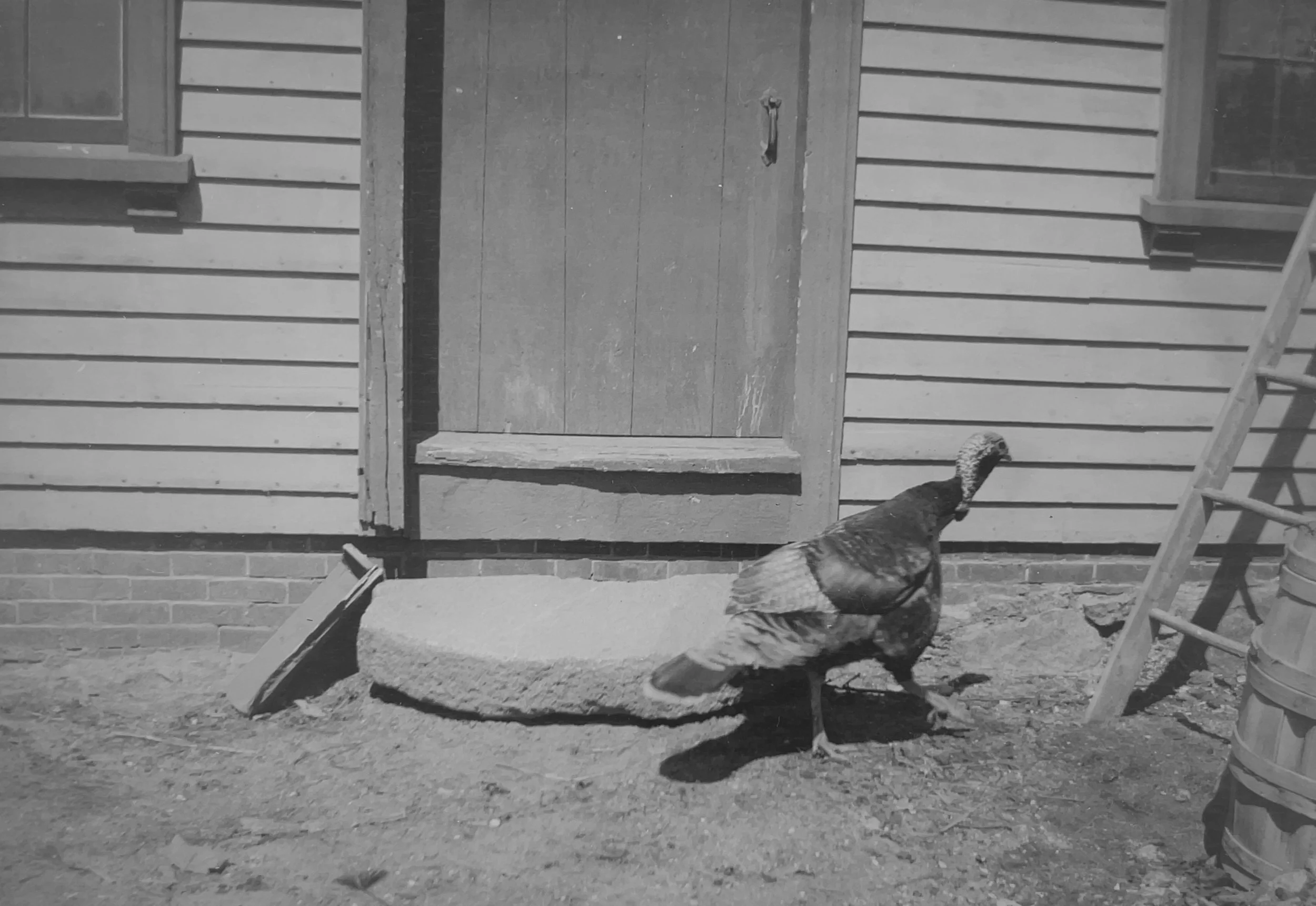
“This is a very seasonable time to talk turkey, for it is well known that in the old days turkey raising was an important industry in New Hampshire. As winter approached, turkeys would be driven over the roads to Brighton and Boston. Often these droves of turkeys would embrace several thousand birds, and as the drove would be augmented by small flocks it passed by farms where turkeys were raised, it generally reached its maximum in Rockingham County. The directing force of a drove of turkeys usually consisted of two or three men, a couple of trained shepherd dogs and a horse and covered wagon, wherein the men slept at night. The cattle drover had to provide barns or fenced enclosures to take care of the herd at night but with a drove of turkeys it was different. When the boss turkey decided to call it a day, the drover had nothing to say about it. In passing a piece of growth the entire flock would suddenly rise from the road and seek perches in the neighboring trees. A favorite route in passing into Massachusetts was through Windham or Salem. Quite often a bird would leave the flock and stop off at some congenial-looking farm, but the sharp-eyed dogs were generally on the alert for just such performances and the fugitive would quickly be hustled back to his mates.”
This was the one- and only-time turkey drives were mentioned in the Exeter News-Letter. It leaves many unanswered questions: when did the turkey drives occur, what time of year was this happening, and were any huge flocks of turkeys driven through Exeter?
Templeton was born in Exeter in 1880. By that time, the railroad system had become the main method of transporting poultry. Templeton’s mother, Ella Gilman, was born in town in 1851 – just a decade after the arrival of the Boston & Maine. If Ernest Templeton had heard stories about turkey drives taking place during the first half of the 19th century, likely he heard it from his mother. There were large cattle drives through town during Ella’s childhood, and those cows were headed to the Brighton market just outside of Boston. If turkeys were also going through town, it seems there would be some notice of them. It’s odd that the record is silent – unless Exeter wasn’t a way-station for turkeys.
A roasted turkey for Thanksgiving was a rare treat. By the 19th century, there were few wild turkeys to be found in New Hampshire having been hunted to near extinction. Farm families might raise one or two for themselves or send a few to market. The News-Letter is filled with accounts of how one might fatten up a domestic turkey for the table.
“In December,” the News-Letter offered in 1846, “the turkeys will be large enough to fatten, and for this purpose select as many as you please, and shut them up – next take to the mill a few bushels of ears of Indian corn and have it ground – then boil potatoes, and mix the meal with scalding water and potatoes in a tub say in the proportion of one bushel of potatoes to one peck or more of meal, and stir them well together, then let it cool, but give it to the turkeys a warm as they will bear it, and as much as they will eat, and in tow weeks and a half, they will be fat enough for market, and for an alderman’s dinner.”
If you did raise a few extra turkeys on the farm, it would be easy to sell them in town. Not everyone kept poultry after all. To make real money with turkeys, you needed to raise a lot of them and get them to the big markets in big cities. There’s little documentation to be found about the turkey drives, but oral traditions were common into the 20th century. Vermont turkey farmers tell similar stories to the one recounted by Templeton. Turkeys were walked to market (and from Vermont it could be nearly 300 miles) in Boston. Vermont Public broadcast a story about the turkey drives in 2014. “We're talking about thousands [of turkeys] in each trip ... Up to 10,000," Peter Gilbert, chair of the Vermont Humanities Council, tells Vermont Edition. "One of the largest drives in the fall of 1824 involved 40 homesteads ... They went all the way from northern Vermont and the Canadian border by a variety of routes, through Ferrisburgh in the west, down the Connecticut River [in the east]."
But in Exeter? Perhaps there were some turkeys taken to Boston, but not enough to secure a place in the written record. A check of several farmer’s diaries mentioned cattle, but not turkeys. Templeton must have been on to something when he mentioned the turkeys travelling through Windham and Salem. Here, apparently, we just ate them.
Barbara Rimkunas is curator of the Exeter Historical Society. Support the Exeter Historical Society by becoming a member! Join online at: www.exeterhistory.org