by Barbara Rimkunas
This "Historically Speaking" column was published in the Exeter News-Letter on Friday, August 7, 2026.
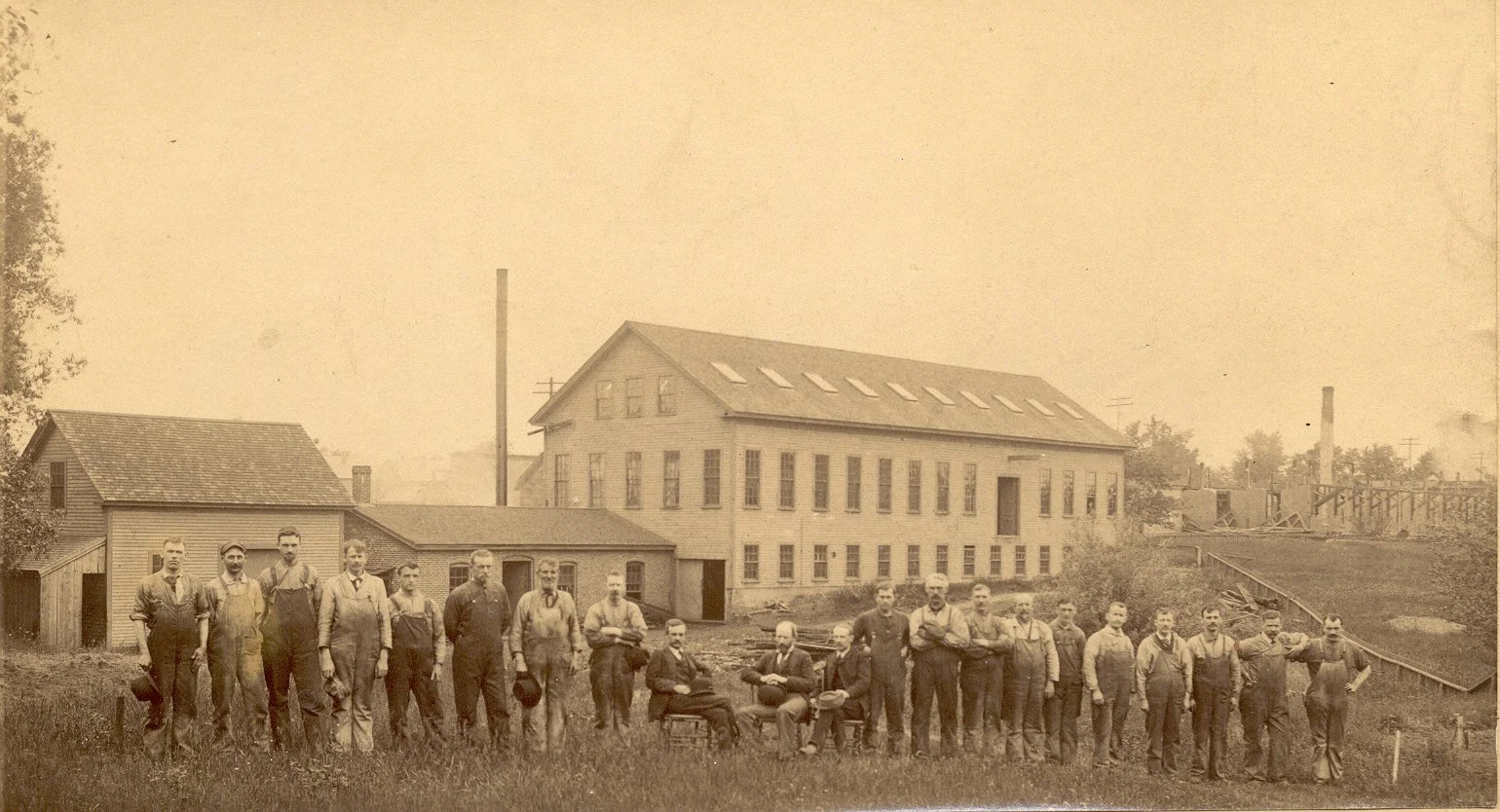
When William Carman, an Exeter steamfitter, needed a workshop in 1884, he chose a piece of land near the Boston and Maine depot on Lincoln Street. The deed mentions no buildings, so it is likely that Carman had his new machine shop built that very year. The area around the depot became the industrial center of Exeter in the decades following the Civil War. The railyard expanded to include passenger service as well as a thriving freight yard, which included a roundhouse and turntable for the huge locomotives. Carman’s machine shop is one of the few structures from this era on the east side of the tracks to remind us of those times. Most Exeter residents won’t recognize the building for its original purpose – most simply remember it as the Exeter Handkerchief Company.
Carman didn’t stay in Exeter very long after he erected the building. For whatever reason, he moved his business to Maine, first to Lewiston and later to Portland. The building next housed an experiment in electricity. The 1880s were still powered by steam and lit by gas. The Exeter News-Letter noted that the Carman property would be adapted for the new occupants, “Messrs. Frenyear & Razee will put in their apparatus and begin work preparatory to supplying the electric light at the depot, machine works, brass shop and shoe factory.” It was to bring in a new era of electric power. There was excitement throughout the town at this proposal. But within a year, it was clear that Frenyear & Razee’s enthusiasm had overshot their capabilities. Creditors came calling and the business went bust.
In 1887, it was announced that two clerks from the Exeter Machine Works, Alfred Fowler and George Warren, had resigned their posts and were setting up their own business, having created a machine that burnished and trimmed heels for the shoe industry. They initially set up their new business in the former Frenyear & Razee building. Orders came quickly to the newly christened Rockingham Machine Company. By 1890, the company outgrew the site and moved across the tracks to a larger facility. Carman’s original workshop didn’t stay idle long. It was purchased by Daniel Gilman for his new enterprise, the Rubber Step Manufacturing Company. Production began in 1892 for a business that began by producing the hard rubber tread one used to alight from a carriage or buggy. Production expanded to rubber treads for Pullman cars. By 1910, they were manufacturing tire coverings for cars and making a variety of products from vulcanized rubber. The business thrived for several decades, only fading with the death of its founder. By 1923, the business was all but shuttered.
The building was purchased that year by Anson Cole, proprietor of the Turner Asbestos Company, which changed hands just four years later to become the Asbestos Products Company. They advertised heat proof dining table pads, mats, traveling ironing boards. In 1929, a new industry joined the Asbestos Products Company at the building – the Exeter Handkerchief Company.
The Exeter News-Letter announced, “this company plans for the present to confine its operations to the production of staple lines, both in ladies’ and men’s goods.” “Of interest to our own citizens is the statement that all of the cloth that will be used for the present will be finished by the Exeter Manufacturing Company.” The Handkerchief Company was the brainstorm of brothers Hervey and Richard Kent; the owners of the cotton textile mill in Exeter’s downtown. Hiring local stitchers, the company turned out handkerchiefs by the tens of thousands. During World War II, it turned to war production and filled government contracts – khaki handkerchiefs for the Army and white for the Navy. Richard Kent remembered to his daughter, Jane, that boys from Phillips Exeter Academy assisted with the heavy packing when labor shortages were most acute.
After the war, the company opened a remnant business to assist local families during post-war shortages. This part of the business proved popular, and Kent began to search outside of the Exeter Manufacturing Company to include fabrics from other mills. He expanded to first-quality fabrics and notions as the need for cloth handkerchiefs declined. Drapery and upholstery departments were expanded in the 1970s. Although alterations were made to the building over the course of the Handkerchief Company’s ownership, the original building still remained. Customers from all over New England arrived in town to visit the Handkerchief Company. Home clothing manufacturing declined in the later decades of the 20thcentury, leaving mostly the decorating arm of the company still intact. The Handkerchief Company has since closed its doors, leaving the future of the old building in question.
Barbara Rimkunas is curator of the Exeter Historical Society. Support the Exeter Historical Society by becoming a member! Join online at: www.exeterhistory.org
The image is a c. 1915 photo of the building when it was the Rubber Step Manufacturing Company.